
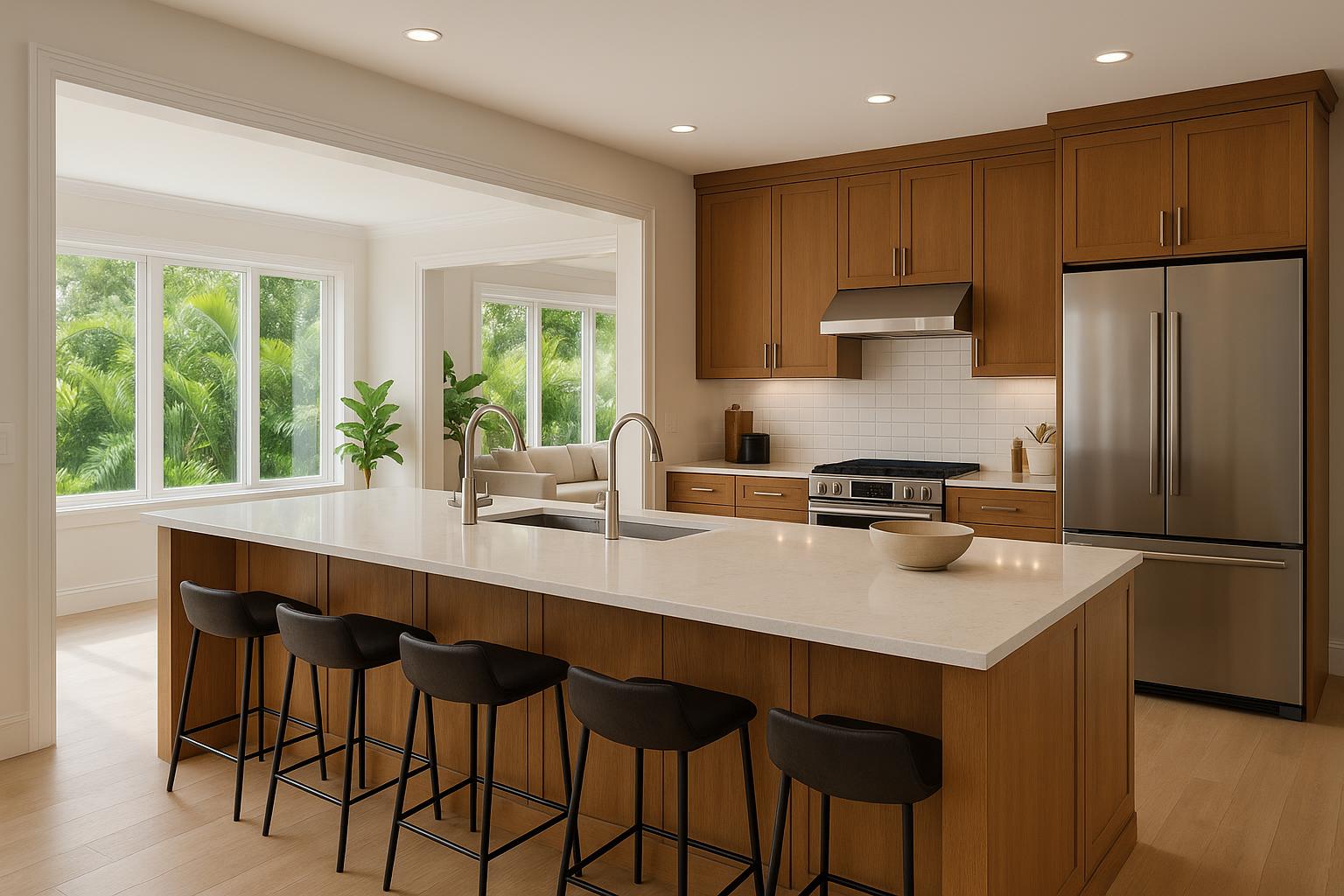
The Great Kitchen Layout Debate
If you're planning a kitchen remodel in West Palm Beach, one of the biggest decisions you'll face has nothing to do with countertops, cabinets, or appliances. It's about walls — specifically, whether to keep them or tear them down.
Open concept kitchens have dominated home design trends for over a decade. But closed or traditional kitchens are making a quiet comeback, and for good reason. Neither layout is universally better. The right choice depends on how you actually live in your home, how you entertain, and what your existing floor plan allows.
At Trinity General Contractors, we've helped homeowners across West Palm Beach and surrounding communities make this exact decision. Here's what you need to consider before committing to either direction.
What Is an Open Concept Kitchen?
An open concept kitchen removes walls between the kitchen and adjacent living spaces — usually the dining room, living room, or both. The result is one large, connected area where cooking, eating, and relaxing flow together without barriers.
You've seen this layout on every home renovation show. It's popular because it creates a sense of spaciousness and keeps the cook connected to family and guests. In many South Florida homes, especially older ranch-style houses and mid-century builds, opening up the kitchen can dramatically transform the feel of the entire first floor.
What Is a Closed (Traditional) Kitchen?
A closed kitchen is a separate, defined room with walls on all sides and one or more doorways leading to other parts of the home. This was the standard layout in most homes built before the 1990s and is still common in many West Palm Beach neighborhoods.
Closed kitchens offer privacy, better odor and noise containment, and more wall space for storage. For serious home cooks, they can also be more functional because everything is within arm's reach.
Pros and Cons of Going Open Concept
Advantages
- More natural light: Removing walls allows sunlight to travel deeper into your home, which is a real benefit in sunny South Florida where you want to maximize those bright interiors.
- Better for entertaining: You can cook and talk to guests at the same time. No more being isolated in the kitchen while everyone else enjoys the party.
- Improved sightlines: Parents can keep an eye on kids in the living room while preparing meals.
- Perceived space: Even if your square footage doesn't change, an open layout makes your home feel significantly larger.
- Resale appeal: Open floor plans remain highly desirable among buyers in the West Palm Beach real estate market.
Disadvantages
- Less wall space: Fewer walls mean fewer places for upper cabinets, shelving, or pantry storage.
- Noise travels: The blender, dishwasher, and range hood are now part of your living room soundtrack.
- Cooking smells spread: That fish dinner won't stay in the kitchen. Every room connected to the open space will know what's for supper.
- Clutter is always visible: There's no closing a door to hide dirty dishes or a messy countertop when guests arrive.
- Structural considerations: Removing walls — especially load-bearing ones — adds complexity and cost to your remodel. Engineering assessments and permits are often required.
Pros and Cons of Keeping It Closed
Advantages
- Maximum storage: Four walls give you the most options for cabinetry, shelving, and pantry space.
- Contained messes: Cooking chaos stays behind closed doors. Your living and dining areas remain presentable.
- Better climate control: A smaller, enclosed room is easier to cool — something worth considering given West Palm Beach summers and rising energy costs.
- Focused workspace: If you love to cook, a closed kitchen can feel like a dedicated workshop where everything is organized and efficient.
- Lower remodel cost: Keeping existing walls intact typically means less structural work, fewer permits, and a simpler renovation overall.
Disadvantages
- Can feel cramped: Especially in smaller homes, a closed kitchen may feel dark or tight.
- Isolation: The cook is separated from family and guests, which can feel lonely during gatherings.
- Less natural light: Enclosed rooms with limited windows can require more artificial lighting.
- May limit resale appeal: Some buyers specifically look for open layouts and may see a closed kitchen as outdated.
Questions to Ask Yourself Before Deciding
Before you tell your contractor to start swinging a sledgehammer — or to leave every wall standing — work through these questions honestly:
- How do you actually use your kitchen? Do you cook elaborate meals daily, or is your kitchen mostly for reheating and coffee? Heavy cooks often prefer closed kitchens. Casual cooks tend to love open layouts.
- How do you entertain? If you host frequently, an open concept lets you stay part of the conversation. If you prefer formal dinner parties with courses, a closed kitchen gives you a staging area.
- How tidy are you — really? Be honest. If dishes pile up and counters get cluttered, an open kitchen puts that on display for everyone.
- What does your floor plan allow? Some homes have load-bearing walls that are expensive or impossible to remove without major structural work. Others have layouts that lend themselves naturally to opening up.
- What's your budget? Removing walls, rerouting electrical and plumbing, and refinishing floors where walls once stood all add to the cost. If your budget is tight, working within your existing layout may be the smarter investment.
The Middle Ground: Semi-Open Layouts
Here's something many homeowners don't realize — you don't have to choose one extreme or the other. Some of the most functional kitchen remodels we've completed in West Palm Beach use a semi-open approach.
This might look like:
- Removing the upper portion of a wall to create a pass-through or breakfast bar while keeping the lower half for counter space
- Widening a doorway into a large cased opening that connects rooms without fully eliminating the wall
- Adding a sliding barn door or pocket door that lets you open up or close off the kitchen as needed
- Installing a large kitchen island that acts as a visual divider between the cooking zone and living area in an open plan
These solutions give you flexibility. You get the connected feeling of an open layout when you want it and the ability to contain noise, smells, and mess when you need it.
Structural Realities in South Florida Homes
One thing worth noting for homeowners in West Palm Beach and surrounding areas like Palm Beach Gardens, Wellington, and Lake Worth Beach: many homes here were built with concrete block construction. Removing walls in a CBS (concrete block and stucco) home is a different process than in a wood-framed house. It's not necessarily harder, but it does require a contractor who understands local building methods and permitting requirements.
Load-bearing walls need to be properly identified and, if removed, replaced with engineered beams and appropriate supports. This is not a DIY project. It requires permits, structural engineering, and experienced hands.
Making the Right Choice for Your Home
There's no single right answer to the open versus closed kitchen question. The best layout is the one that matches how you live — not what looks best on a screen. A well-designed closed kitchen can be just as stunning and functional as a wide-open floor plan, and vice versa.
What matters most is working with a remodeling team that listens to your priorities, evaluates your home's structure honestly, and builds a kitchen that works for your life — not just for resale.
If you're considering a kitchen remodel and aren't sure which direction to go, Trinity General Contractors can help you evaluate your options. We work with homeowners throughout West Palm Beach and the surrounding communities to design and build kitchens that look great and function even better. Reach out to start the conversation.